What to Do Before Looking at Charts: A Morning Prep Routine for Day Traders
You open TradingView at 9:15 ET and start scanning. ES is gapping up 0.4%, the overnight range looks tight, and you're already eyeballing a breakout level. By 9:32 you've taken a trade based on nothing but a gut read. By 9:45 you're stopped out.
I did this for weeks before I realized the problem wasn't my entries. It was that I never showed up with a plan. And some mornings, I shouldn't have been trading at all.
Why Prep Before Charts Matters
The single most important thing about morning prep is the order: you think first, then look. Not the other way around.
This isn't arbitrary. It's about anchoring bias -- one of the most well-documented cognitive biases in decision-making research. Kahneman and Tversky showed that the first piece of information you encounter disproportionately shapes every judgment that follows. In trading, the first piece of information is usually price.
If you open ES at 9:10 ET and see it's up 12 points from yesterday's close, your brain has already formed a directional opinion before you've reviewed a single note. You're anchored. Now every observation you make -- overnight range, key levels, playbook rules -- gets filtered through that initial bias. You don't think "what does my data say?" You think "how does my data confirm what I already see?"
That's why the prep comes before the chart. Steps 1-4 below happen with TradingView closed. You load yesterday's lessons, check your rules, spot weekly patterns, and mark levels. Only then do you open the chart. By that point, you've already formed a plan from your own data. The chart confirms or invalidates it -- it doesn't create it.
Traders who skip prep aren't lazy. They just don't realize that looking at price first has already compromised their objectivity. The prep is a bias firewall.
Step Zero: The State Gate
Before you touch a single chart, check yourself. Slept five hours. Still annoyed about yesterday's stop-out. Didn't do any prep. That's three red flags and you haven't even opened TradingView yet.
The State Gate is a 30-second mental readiness check: sleep quality, emotional state, focus level, revenge trading risk, and whether you actually completed your prep. If two or more are red, you have no business sizing up today. Trade smaller or sit out entirely.
This sounds obvious. It isn't. I've blown through more P&L on tilt mornings than on bad setups. The State Gate catches it before the chart does. (If you've ever found yourself chasing after a stop-out, the revenge trading pattern is predictable and fixable -- here's how.)
Your Execution Script Loads First
Once you clear the State Gate, your Execution Script loads -- your personal trading constitution. The rules you committed to. Max loss per day. Position sizing. What you will and won't trade. You wrote this on a clear-headed Sunday, not at 9:34 ET with a candle moving against you.
It takes 30 seconds to read. It resets your frame before the market pulls you somewhere you didn't plan to go.
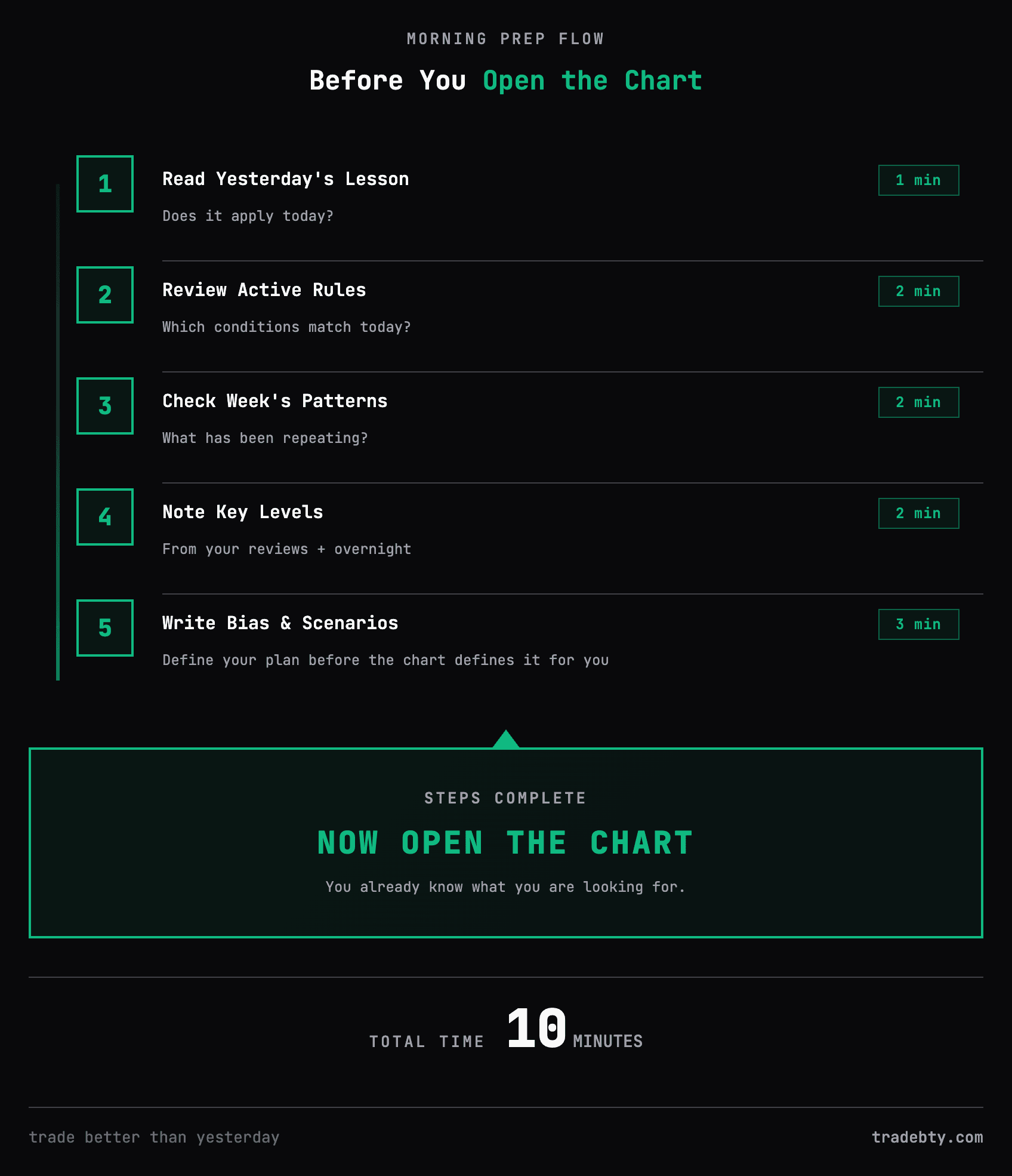
The 5-Step Morning Prep (10 Minutes)
Step 1: Read Yesterday's Lesson (1 min)
Open yesterday's review. Read the key takeaway. Does it apply today? If yesterday's lesson was about narrow opening ranges failing and the overnight range is tight again, it's active.
This is where the closed loop kicks in. Last night's structured voice review captured the lesson. This morning's prep loads it. No digging through old notes.
Step 2: Check Active Rules (2 min)
Pull up the IF/THEN rules from your last 2-3 reviews and your playbook. Which ones match today's conditions? Those go on your watchlist.
This is the step that prevents overtrading. If your playbook has 3 active rules and only 1 matches today's context, you have 1 setup to watch. Not 5. Not "whatever looks good." One. You wrote the rules on a clear-headed day. Trust them on a fast-moving one.
Step 3: Spot This Week's Patterns (2 min)
Scan the last 3-5 reviews for recurring observations. Opening range breakouts failing? VWAP acting as a magnet in the afternoon? If a pattern showed up 3+ times this week, it's probably still active. (And if a pattern that used to work keeps failing, it might be decaying.)
Step 4: Mark Key Levels (2 min)
From yesterday's review and the overnight session: yesterday's high and low, levels that held multiple times, the overnight range. These aren't generic levels from a charting tool. They're levels your own reviews flagged as important.
Step 5: Write Bias and Scenarios (3 min)
NOW open the chart. With Steps 1-4 loaded, write your bias (long, short, or neutral), 2-3 scenarios, and what invalidates each one. This is a plan with defined actions, not a prediction.
Example -- filled in at 9:15 ET:
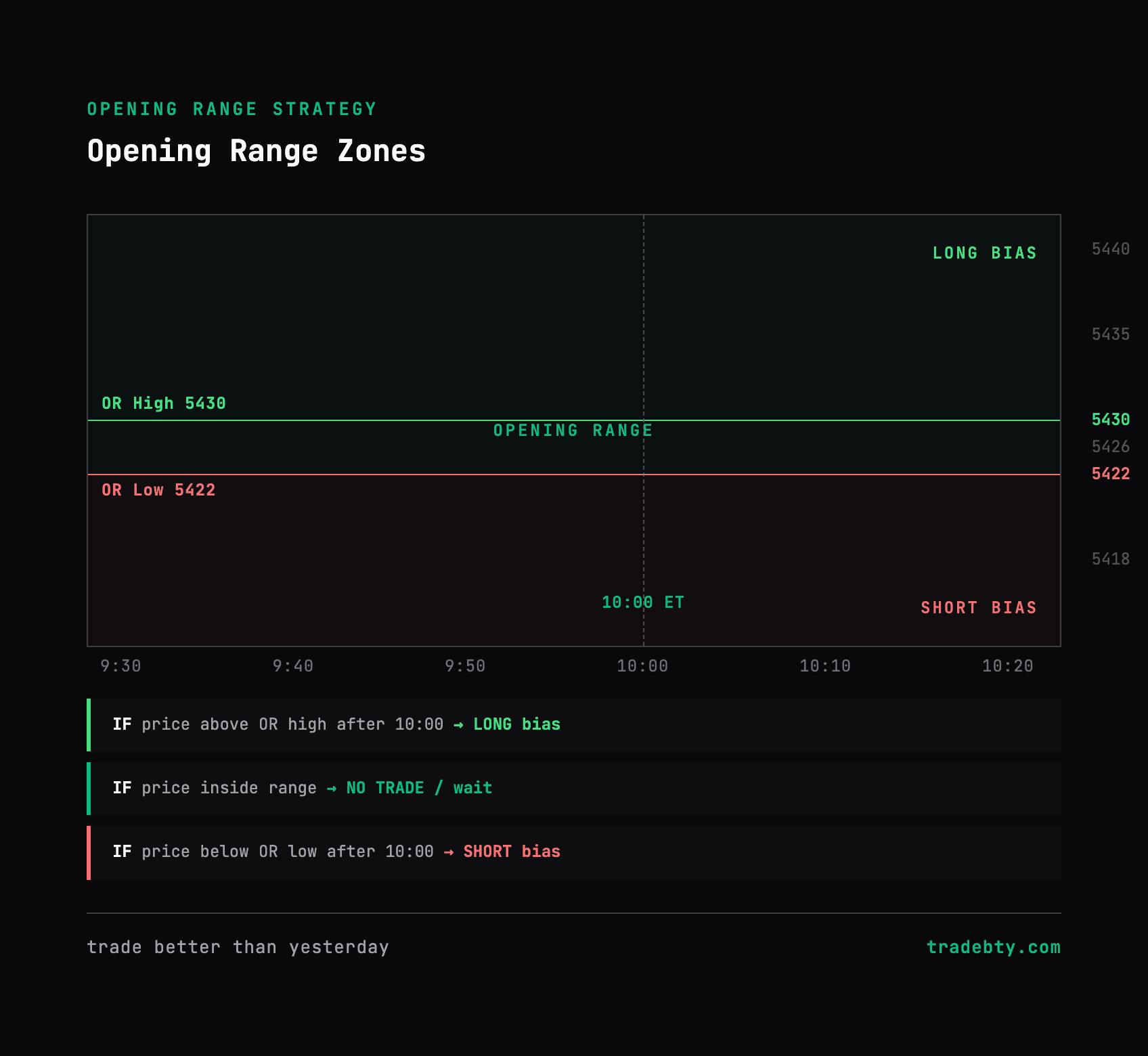
- -Overnight range: H 5435, L 5418 (17 points)
- -Key levels: 5420 (yesterday close), 5430 (rejected 3x yesterday)
- -Bias: Neutral-to-long -- held above 5420 overnight
- -Scenarios: (1) OR > 10 points, breakout with internals confirming -- take per rule. (2) OR < 8 points -- sit on hands. (3) Opens below 5420: flip bearish.
- -Invalidation: Thesis breaks if price loses 5418 on volume.
Ten minutes. Now you open the chart knowing what you're looking for and what disqualifies each setup.
What to Capture: The Four Prep Fields
Every morning prep should answer four questions. Not five, not ten. Four.
1. Yesterday's key lesson. One sentence. "Narrow opening ranges faked breakouts all day -- wait for the 2-minute hold before entering." This comes directly from your evening review. If you didn't review last night, this field is blank, and that blank is a signal: you're flying without instruments.
2. Today's plan. Which 1-3 playbook rules are live today? Write them down. "Gap fade is live (gap = 0.8%). Failed breakout fade is on watch (OR width TBD). Afternoon reversion: log only, half size." This is your complete shopping list. Anything not on the list doesn't get traded. Run your position size calculator now, before the open, so you know exactly how many contracts fit your risk budget for each setup.
3. Invalidation points. Where does your thesis break? "If ES loses 5418 on volume, I'm wrong. If the gap fills and holds, the fade is dead." These are the conditions that make you stop, not the conditions that make you enter. Most prep routines skip this. Invalidation points are the most valuable part -- they're what keeps you from holding a losing thesis all day.
4. Focus areas. What are you working on as a trader this week? Maybe it's "don't enter before the 2-minute hold confirms" or "reduce size after the first loss." This isn't about the market. It's about you. The State Gate checks whether you're fit to trade. The focus area tells you what skill you're building today.
How Prep Prevents Overtrading
Here's the mechanism. If you planned 2 setups and you've already taken both by 10:30 ET, your trading day is functionally over. Not because you can't take more trades, but because any additional trade would be unplanned -- and unplanned trades are where most losses hide.
Without prep, there's no boundary. Every price movement is a potential setup. Every 5-minute candle might be "the one." You take 7 trades by noon because nothing told you to stop at 2.
With prep, the boundary is written down before the open. "Today I'm watching the gap fade and the failed breakout fade. That's it." If neither triggers, you sit. If both trigger and resolve by 10:00 ET, you're done.
The prep doesn't just tell you what to trade. It tells you what to ignore. That second function is more valuable than the first. Most overtrading isn't caused by greed. It's caused by having no plan to measure against. A vague note like "be more selective" doesn't fix this -- you need a specific, written list of what counts as selective today. (For more on why vague advice fails, see why "be patient" is the worst trading advice.)
The Feedback Loop: Prep and Review
Morning prep and evening review are two halves of the same system. Neither works without the other.
The evening review captures what happened: key turning points, rule grades, the one lesson from today's session. (The full 9-section review template covers this.) That review feeds directly into tomorrow's morning prep.
Tomorrow morning, Step 1 loads today's lesson. Step 2 loads the rules you graded tonight. Step 3 references the patterns you've been logging all week. Each prep session draws on the accumulated data from every previous review.
After a week, you know which reviews you keep referencing. After a month, your morning prep draws on 20+ data points instead of whatever you saw on the overnight chart. After three months, you've built a personalized filter that tells you -- based on your own trading history -- which setups are worth watching today and which ones aren't. If you're new to ES futures, the beginner's guide to ES day trading walks through exactly when to add morning prep to your routine (Week 2 of the 30-day plan) and why it's the single biggest upgrade after building the review habit.
That's the loop: review tonight, morning prep loads the lessons, State Gate checks readiness, trade the plan, review again. Each cycle sharpens the next one.
Without the review, the prep has nothing to load. Without the prep, the review's lessons never reach the next trading session. Both halves are mandatory.
What If You Skip a Day?
Some mornings you won't do the prep. Maybe you overslept. Maybe you're traveling. What happens?
The honest answer: your trading quality drops. Not because the market changed, but because you're operating without the filter that keeps you focused. You'll see more "setups" because nothing is telling you to ignore them. You'll take trades that aren't in your playbook because you didn't load your playbook.
The fix isn't guilt. It's a rule: if you didn't complete the prep, reduce your size by half. Or don't trade. You wrote the Execution Script for exactly this scenario. One of its rules might be: "No prep, no full-size trades."
Skipping prep occasionally is human. Skipping it and trading full size is a compliance break. Your evening review will catch it -- and over time, you'll see the correlation between no-prep days and P&L.
The 10-Minute Investment
Ten minutes before the open. That's it.
Read yesterday's lesson. Check your rules. Spot the week's patterns. Mark levels. Write your bias.
It sounds small because it is small. But those ten minutes are the difference between showing up with a plan and showing up with a chart and a feeling. One of those approaches compounds over 100 sessions. The other one doesn't.
TBTY builds this loop into the workflow. Voice-review after the close, morning prep pulls your lessons and active rules automatically, and Plan Compliance tracks whether you followed through. $9/mo founding rate, locked for life. Start here.
Keep Reading
- -The 9-Section Trading Review Template -- the evening review that feeds tomorrow's morning prep.
- -How to Turn Trading Observations Into Testable Rules -- the pipeline that creates the rules your prep loads each morning.
- -Overtrading a Small Account: How to Actually Stop -- when prep prevents you from taking trades that aren't on the list.
- -Best Time to Day Trade ES Futures -- why "trade the open" is too blunt, and how to match your setups to the right session.
TBTY is an educational approach to structured trading review. Examples use ES futures for illustration only. Past patterns do not guarantee future results. Trading involves risk of loss. Always do your own analysis.
Want the complete framework?
This article is adapted from the TBTY framework. Get the free Quick Start Guide delivered immediately — two core ideas that fix most reviews.
Get the Free Quick Start Guide