When Your Best Trading Setup Stops Working (And What to Do About It)
I watched one of my best rules die over six weeks. Here's exactly how it happened.
6 Weeks With an Opening Range Breakout
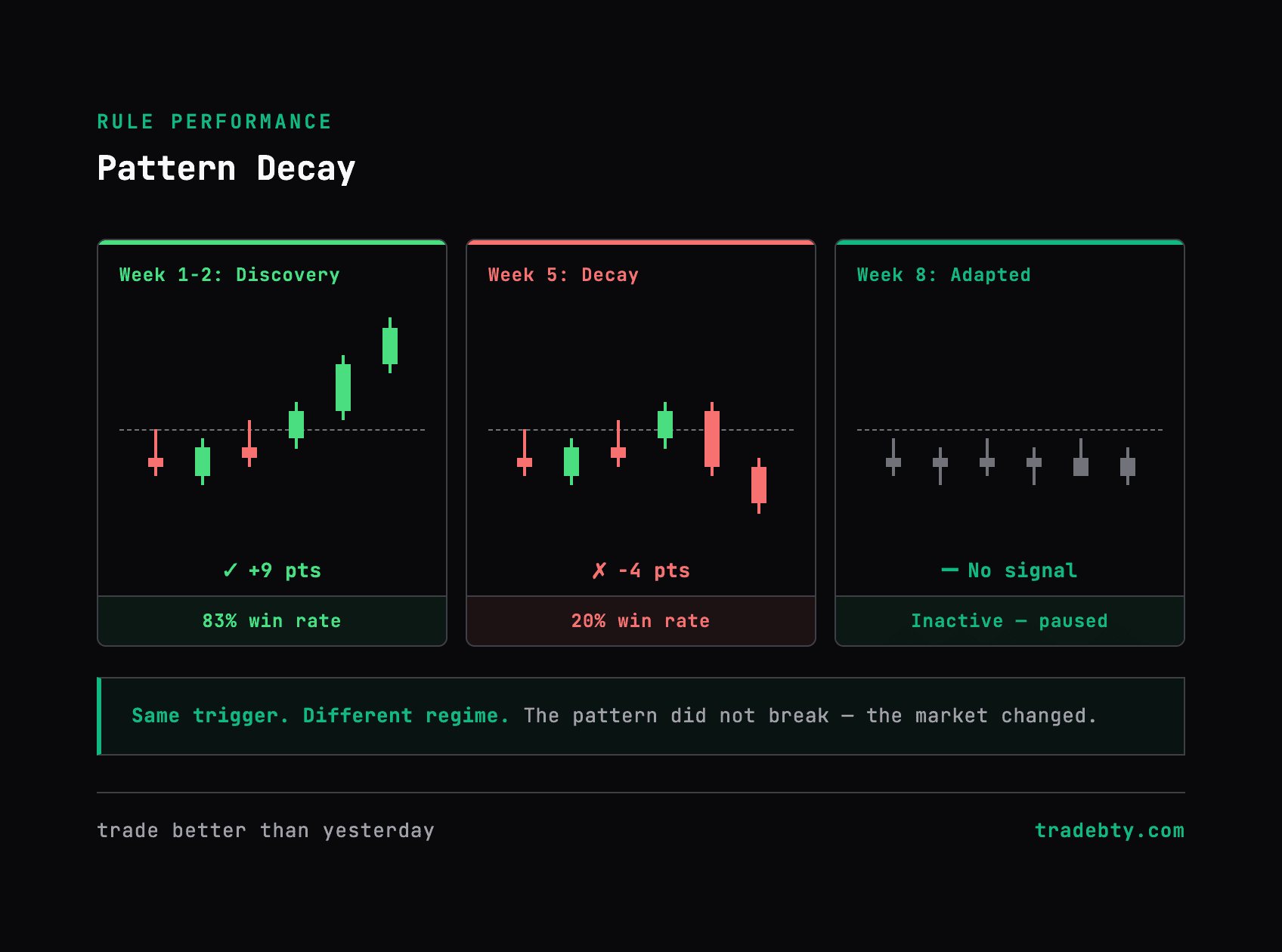
Weeks 1-2: Discovery. I noticed ES opening range breakouts where price held above the OR high for 2+ minutes ran cleanly. Breakouts that faded back immediately failed. I wrote the rule, started tracking, and logged an 83% win rate over 12 signals.
Weeks 3-4: Peak. The rule hit 8 out of 9. Promoted it to my active playbook. Tuesday morning, OR broke at 9:36 ET, held for 3 minutes with TICK (measuring real-time upticking versus downticking NYSE stocks) above +600, and ran 14 points in 20 minutes. The setup at its best.
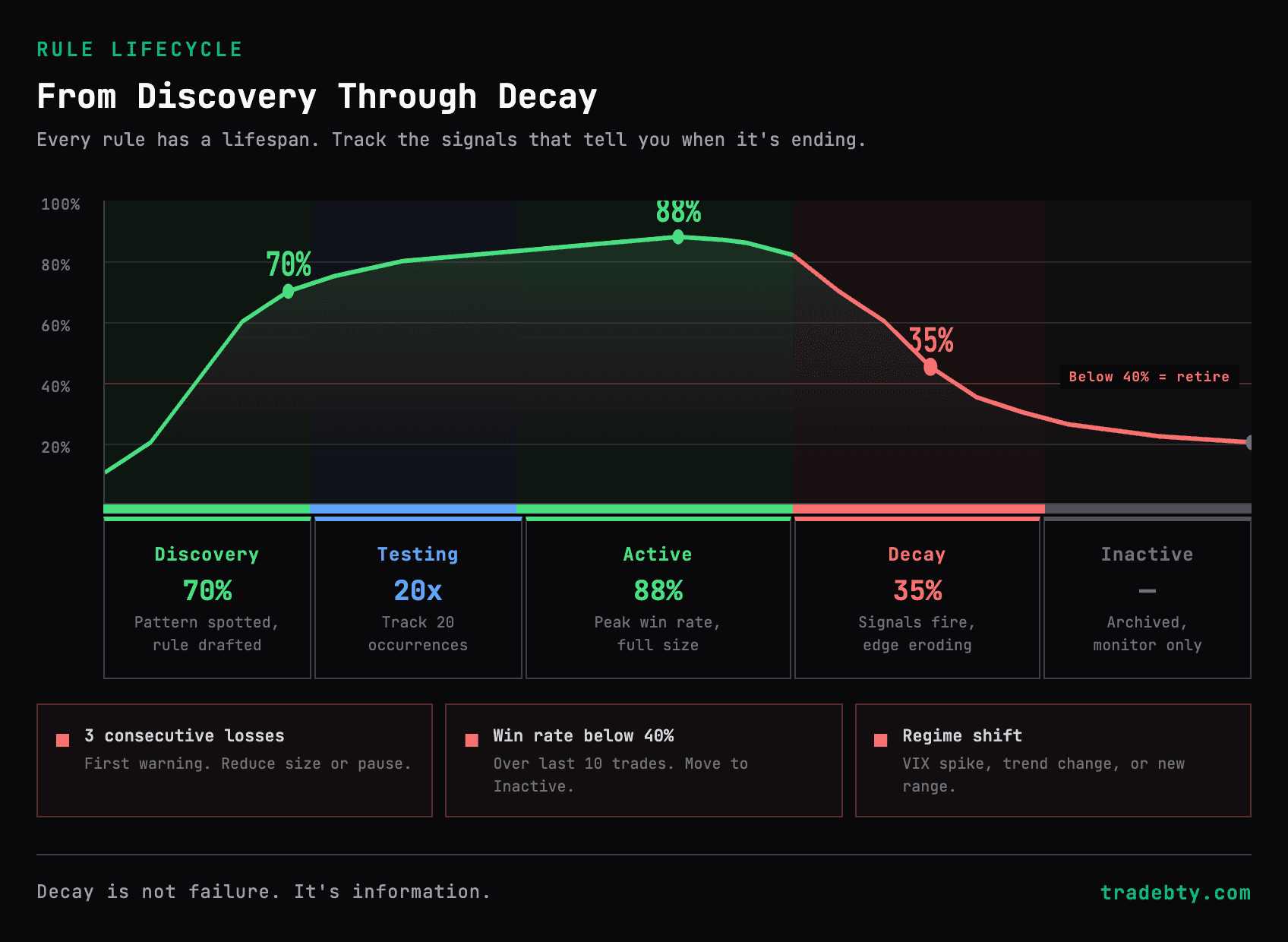
Week 5: Decay. VIX spiked from 14 to 21 on Monday. That day's breakout reversed within 3 minutes. Tuesday, same. Wednesday, same. Three consecutive losses. Recent win rate over the last 5 signals: 20%. My lifetime rate still said 71%, but lifetime is lagging. Recent is leading.
That's decay signal number one -- recent win rate drops below 40%. Signal number two -- three or more consecutive losses. A rule that wins 65% of the time losing three straight happens about 4% of the time by chance. When it does, decay is more likely than bad luck.
But there was an earlier signal I should've caught. The VIX spike itself -- a 50% jump in a single day -- is signal number three: a regime shift. When VIX moves that fast, every breakout rule in your playbook deserves an immediate audit.
Week 6: Watch. Moved the rule to Watch status. Tracked signals, didn't trade them. Two signals fired. One won, one lost. Pattern confirmed dead in this regime.
Weeks 8-9: Reactivation. VIX dropped back to 15. Two breakout signals worked in a row. Reactivated at half size. Five more signals maintained 60%+, returned to full size.
Total damage from the decay: 3 losses, caught in under a week. Without tracking, those 3 easily become 10+.
The Difference Between a Drawdown and a Dead Setup
This is where most traders get confused. Three losses in a row feels terrible, but it doesn't automatically mean the setup is broken. The distinction matters:
A drawdown is a normal statistical cluster of losses within a functioning edge. A rule that wins 65% of the time will have three-loss streaks. It will even have four-loss streaks occasionally. That's math, not decay. The conditions that define the setup still appear, the trigger still fires correctly, and the follow-through is still present -- you just hit the wrong side of the distribution.
A dead setup is a structural change. The conditions that made the rule work no longer exist. Maybe VIX doubled and breakouts don't carry anymore. Maybe a new overnight session dynamic changed how the opening range behaves. The pattern fires, but the outcome has fundamentally shifted.
How to tell the difference: check the context, not just the results. If your gap fade rule lost three times, ask why. Were the gaps within the 0.5-1.0% range your rule specifies? Was TICK confirming? Were all your filters met? If yes, it might be a drawdown -- the setup fired correctly and lost. Drawdowns end on their own.
If the losses came with different market behavior -- gaps running further than they used to, VWAP not holding, follow-through dying within minutes instead of carrying -- that's structural. The market changed. Your rule didn't.
The tracking table tells you which one you're in. Without data, every losing streak feels like the end. With data, you can see whether the setup is performing within expected parameters or has genuinely broken.
Signs a Setup Is Decaying (Not Just Losing)
Decay doesn't always announce itself with three dramatic losses. Sometimes it's subtler. Here are the patterns that precede a full breakdown:
Shrinking winners. Your breakout rule used to run 10-14 points. Now it's running 5-7. Same setup, same entry, but the follow-through is weaker. The win rate might still look okay, but the R:R is compressing. If your average winner drops by 30% or more over the last 5-7 occurrences, something changed.
Longer time to target. Moves that used to complete in 20 minutes now take 45. The direction is right, but the momentum is gone. This is common when VIX is declining -- breakouts still work, but they grind instead of run. If your stop gets tested more on winning trades than it used to, the setup is weaker even if it still technically wins.
More signals graded N/A. The pattern stops appearing. Five sessions in a row where the condition never triggers. This isn't a loss -- it's absence. And absence is a decay signal too, because it means the market conditions that create the setup aren't present. If the conditions return, the rule might still work. But if they don't return for 2+ weeks, the regime has shifted.
Near-misses becoming losses. Trades that would have hit your target last month are now stopping out by a point or two. The setup is still forming, the entry is still valid, but the market isn't giving you the margin it used to. This is often the first sign of decay, and the easiest to dismiss as bad luck.
Track these signals alongside your win rate. A rule can look "fine" on win rate alone while degrading on every other metric.
The Middle Case: Adapt Instead of Kill
Not every decaying rule is dead. My gap fade rule (short when ES gaps 0.6-1.0% and VWAP rejects twice) ran 74% over 19 occurrences. Then gaps started running further. Win rate dropped to 50% -- three losses came from a stop too tight at 2 points above VWAP.
Adapted: widened the stop to 3.5 points and added a filter requiring the gap to be under 1.2%. Win rate recovered to 63% over the next 12 signals. Still worth trading. (Before adjusting the stop, I ran the new numbers through a risk/reward calculator to confirm the wider stop still kept the R:R above 1:1.)
The difference between "adapt" and "kill": if the core pattern still appears and the trigger fires correctly but the outcome is weaker, try tightening a filter or adjusting the stop. If the pattern stops appearing entirely, that's a kill.
Adaptation examples that work:
- -Widening a stop by 1-2 points when volatility increases (VIX went from 14 to 18)
- -Adding a time filter ("only before 10:30 ET") when afternoon signals start failing
- -Requiring stronger confirmation (ADD above +600 instead of +400) when marginal signals degrade
- -Reducing the target when follow-through shrinks (take 8 points instead of 12)
Adaptation examples that don't work:
- -Changing the core trigger (from breakout to mean-reversion) -- that's a new rule, not an adaptation
- -Removing filters to get more signals -- this almost always makes things worse
- -Widening the stop so far that R:R drops below 1:1 -- now you need 60%+ just to break even
One refinement at a time. Change the stop, track 10 signals. If it recovers, keep it. If it doesn't, try the next adjustment. Two failed adaptations in a row? Move to Watch status.
The Emotional Trap: Holding Onto a Setup That Used to Work
This is the hardest part. Not the mechanics -- the psychology.
A setup that made you money for three months feels like yours. You built it from your own observations. You tracked it through 20+ occurrences. You promoted it into your playbook. It has history.
And now it's failing, and you don't want to let go.
I've watched myself do this. The breakout rule was my best performer. When it started decaying, I kept trading it at full size for two extra days because I "knew" it worked. Those two days cost me more than the previous three losses combined.
The emotional attachment shows up in specific ways:
Cherry-picking confirmations. "Well, the ADD was only at +350, but last time it worked at +300, so..." You're lowering your own bar because you want the signal to fire. If you find yourself making exceptions for a rule that used to need none, the rule is decaying and your attachment is hiding it.
Blaming execution instead of the rule. "The setup was fine, I just entered a candle too late." Maybe. But if your execution was fine for 20 trades and suddenly it's "wrong" for 3 straight, the more likely explanation is the setup, not you.
Refusing to move to Watch status. "Three losses isn't enough to bench it." Maybe it isn't -- if the conditions were met and the losses were within normal variance. But if the market regime changed and you're still arguing for the old rule, you're not being disciplined. You're being stubborn. It's the same emotional pattern behind revenge trading -- you're letting the last outcome override the current evidence.
The fix isn't emotional. It's procedural. Set the decay thresholds in advance: recent win rate below 40%, or three consecutive losses, or a regime shift. When any of these triggers hit, the rule moves to Watch. Not because you feel like it should. Because the protocol says so. You wrote the protocol on a Sunday afternoon when you had no positions and no bias. Trust that version of yourself.
The 5 Decay Signals
- 1.Recent win rate below 40% (last 5-7 occurrences, not lifetime)
- 2.Three or more consecutive losses
- 3.Market regime shift (VIX spike, surprise FOMC, geopolitical shock)
- 4.Pattern fires but outcome changes (trigger works, follow-through dies)
- 5.Pattern stops appearing (5+ sessions graded N/A)
Without tracking, you can't tell when a setup's dying. These five signals require data. Which means you need to be reviewing consistently -- not just on bad days.
Tracking Setup Health Over Time
Your active playbook shouldn't just list rules. It should show their vital signs.
For each active rule, track:
- -Lifetime win rate -- your confidence number, based on all tracked occurrences
- -Recent win rate -- last 5-7 signals, your early warning system
- -Average winner vs. average loser -- R:R tells you if the rule is still worth the risk
- -Current streak -- consecutive wins or losses
- -Days since last signal -- detects absence-based decay
When recent win rate diverges from lifetime by more than 20 points, something changed. When R:R compresses below 1:1, the math stops working even if you're winning more than half. When the last signal was 10+ sessions ago, the pattern may have left the building.
Your morning prep should surface this data before the bell. "Gap fade rule: lifetime 68%, recent 3 of last 7 (43%). Watch status recommended." You see that at 9:10 ET and adjust before you take a decayed setup at full size.
What to Do About It
When decay signals appear, don't keep trading the setup and don't delete it. Move it through the three tiers in your trading playbook: Active (proven, full size), Watch (decay signals present, track only or half size), and Inactive (dead in this regime, revisit when conditions return).
Inactive doesn't mean dead forever. The breakout rule that died at VIX 21 came back at VIX 15. If you tracked what killed it, you know exactly when to look for it again.
This is where Plan Compliance matters. When a rule is on Watch status and you trade it at full size anyway -- that's a compliance break. Your evening review catches it. Your morning Execution Script reminds you of current tier assignments. The system only works if you follow the system.
The traders who survive long enough to compound aren't the ones who find the perfect setup. They're the ones who detect decay early, adapt when possible, retire when necessary, and reactivate when conditions return. That's not talent. That's a pipeline. And it starts with turning observations into rules you can actually track.
TBTY tracks rule performance across sessions and flags decay automatically. Voice-review after the close, and the data accumulates without a spreadsheet. $9/mo founding rate, locked for life. Start here.
Keep Reading
- -How to Build a Trading Playbook from Your Reviews -- the Active/Testing/Inactive tiers that catch decay before it costs you.
- -How to Turn Trading Observations Into Testable Rules -- when a decayed rule needs refinement, this pipeline applies.
- -Morning Prep Before Looking at Charts -- how tier status loads into your daily plan so you don't trade Watch rules at full size.
TBTY is an educational approach to structured trading review. Examples use ES futures for illustration only. Past patterns do not guarantee future results. Trading involves risk of loss. Always do your own analysis.
Want the complete framework?
This article is adapted from the TBTY framework. Get the free Quick Start Guide delivered immediately — two core ideas that fix most reviews.
Get the Free Quick Start Guide